
A customer has finished their appointment, collected their car, completed their treatment, attended their class or received the service they paid for.
The transaction is complete.
For many businesses, that is also where the customer journey quietly stops.
The customer leaves. Their details remain somewhere in a booking system, WhatsApp conversation or CRM. The team moves on to the next person.
Then weeks or months later, the business starts looking for more customers.
That creates an expensive pattern: constantly acquiring customers who could have become repeat customers instead.
Customer retention is often discussed as a marketing problem. Loyalty programmes, discounts, memberships and rewards usually dominate the conversation.
Those things can help.
But for many service businesses, retention starts somewhere much more basic:
Does the business know what should happen after the first visit?
Customer retention starts before the customer needs you again
A customer rarely wakes up thinking about your retention strategy.
They simply reach a point where they need the service again.
- A dental patient is due for another check-up.
- A customer needs their next car service.
- A physiotherapy patient has another session in their treatment plan.
- A salon client is approaching the point when they would normally return.
- A business customer needs the same service again.
The opportunity existed long before the customer actively started searching.
The question is whether the business recognised it.
A useful customer retention process connects three things:
What happened last time → what should happen next → when it should happen
If those three pieces are disconnected, repeat business becomes dependent on customer memory.
And customer memory is competing with every other business trying to get their attention.
1. Know whether there should be a next visit
Not every customer should receive the same follow-up.
Someone who bought a one-off service may not need another interaction for months.
Someone halfway through a treatment programme may need to return next week.
Another customer may have completed their first appointment but never booked the recommended follow-up.
This is where customer context matters.
The business should be able to tell:
- what the customer last purchased or booked
- when that happened
- whether another visit was recommended
- when they would normally return
- whether the next visit has already been booked
- whether any follow-up is still outstanding
Without that context, retention quickly turns into mass messaging.
“Hi, we haven’t seen you in a while.”
That might be relevant.
It might also be completely wrong.
Good customer follow-up starts with knowing why you are contacting someone.
2. Make the next step clear before the customer leaves
One of the easiest ways to improve repeat visits is also one of the least glamorous:
Make sure the customer knows what should happen next.
Consider two experiences.
In the first:
“Thanks, see you again.”
In the second:
“You’ll be due again in six weeks. Would you like to book that now?”
The service may have been identical.
The second journey simply makes the next action explicit.
This matters because customers are much more likely to complete something while the context is still fresh.
Once they leave, the responsibility shifts entirely to them.
- They have to remember.
- They have to decide when to return.
- They have to contact the business again.
- They may have to explain what they need.
Each extra step creates another opportunity for the repeat visit to disappear.
3. Separate reminders from follow-up
Reminders and follow-up are related, but they solve different problems.
A reminder helps someone complete something already planned.
For example:
- tomorrow’s appointment
- an upcoming payment
- a scheduled service
- a confirmed consultation
A follow-up helps move an unfinished or future customer journey forward.
For example:
- a customer who should schedule their next visit
- someone who received a recommendation but has not acted on it
- a customer who said they would decide later
- someone due to return but who has no future appointment
This distinction matters.
Sending more reminders will not fix a rebooking problem if there is nothing booked to remind the customer about.
The business first needs to identify who should be coming back.
Then it needs a sensible reason and timing for contacting them.
4. Use timing, not just frequency
Poor retention campaigns often focus on frequency.
- “Message customers every 30 days.”
- “Send a monthly promotion.”
- “Check in three times.”
But customer retention is usually more about timing than volume.
The best moment to contact a customer depends on the business.
- A car workshop might know when the vehicle should next be serviced.
- A clinic may know when a follow-up appointment is expected.
- A salon may understand the typical interval between services.
- A professional-services business may know when a contract, filing or recurring task becomes relevant again.
The timing is already hiding inside the customer journey.
Retention improves when businesses use that information instead of treating every previous customer as part of one generic mailing list.
5. Remove friction from rebooking
Getting the timing right is only half of the job.
The customer still needs to act.
If your message says:
“You’re due for your next visit.”
and the customer has to call the business, wait for a reply, ask for availability and go back and forth over possible times, the retention process still contains unnecessary friction.
A stronger journey looks more like:
Customer is due → customer is contacted → suitable options are available → customer chooses → booking is confirmed
The fewer steps between recognising the need and completing the next booking, the stronger the rebooking process becomes.
This is especially important for businesses where WhatsApp is part of normal customer behaviour.
A customer may simply reply:
“Saturday can?”
That should be treated as a meaningful step toward the next visit, not the beginning of another manual administrative process.
6. Pay attention to customers who were expected back but never returned
One of the most useful retention questions a business can ask is:
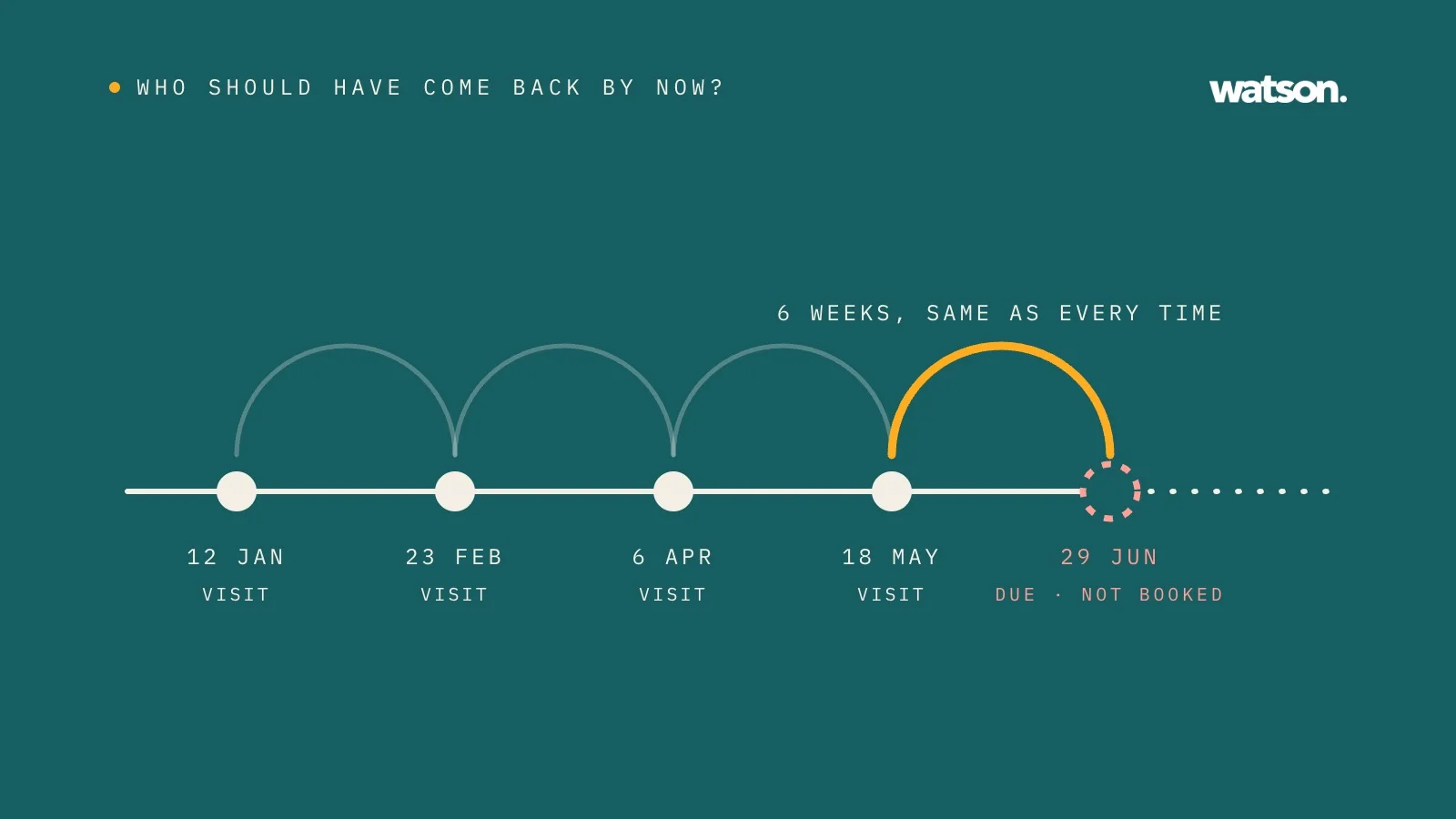
Who should have come back by now?
That is different from asking:
Who are our old customers?
The first question contains intent.
A customer who visited three months ago may be perfectly normal.
Another customer who visited three months ago may be six weeks overdue.
Without context, both look identical.
This is where reactivation becomes more useful.
Instead of periodically sending broad campaigns to every inactive customer, businesses can identify people whose behaviour has changed.
For example:
- customers who normally return every month but have not returned for three
- patients who completed one visit but not the recommended follow-up
- customers with unfinished treatment or service plans
- previous buyers who have crossed their normal repurchase window
- customers who previously engaged but never completed the next step
These groups are much more meaningful than simply “everyone who has not purchased recently.”
7. Keep the customer history connected
Retention gets harder when each interaction starts from zero.
The customer called last month. Then they booked through WhatsApp. Then they rescheduled. Then they returned six weeks later.
If those interactions sit in separate systems, the business may know the customer exists without actually understanding their journey.
Connected context helps the team answer basic questions quickly:
- What happened last time?
- What did the customer book?
- What were they told?
- When were they supposed to return?
- Has anyone already followed up?
- Is something still outstanding?
This is not simply a CRM problem.
It is an operational problem.
The more disconnected the customer history becomes, the harder it is to create relevant follow-up without asking staff to manually reconstruct the story.
Customer retention is not the same as customer loyalty
The two are related, but they are not identical.
Customer loyalty describes the customer’s preference or attachment to the business.
Customer retention describes whether the customer continues doing business with you.
A customer may like your business and still fail to return.
- They forgot.
- They got busy.
- They could not find a suitable time.
- Another business contacted them first.
- They never received the follow-up they expected.
Their loyalty did not necessarily disappear.
The process did.
That is why businesses should be careful about treating every lost repeat visit as a branding problem.
Sometimes the customer simply needed a clearer path back.
A simple customer-retention workflow
For many service businesses, a practical retention journey can be reduced to:
Service completed → next need identified → timing recorded → customer contacted → customer responds → rebooking completed → future context retained
Now look at each transition.
- Where does someone need to remember to do something manually?
- Where could the customer disappear?
- Where does information have to be copied into another system?
- Where does the customer have to start again?
Those gaps are where retention becomes unreliable.
What should a business measure?
Retention metrics can become complicated quickly, but businesses can start with a few useful questions.
Repeat customer rate
What percentage of customers return?
Rebooking rate
How many customers who should have another appointment actually schedule one?
Time between visits
Are customers returning within the expected period?
Follow-up completion
How many customers who require follow-up are actually contacted?
Reactivation rate
How many inactive or overdue customers return after outreach?
Customer retention rate
How many customers remain active over a defined period?
The exact metric depends on the business model.
A dental clinic should not measure retention exactly like an automotive dealership.
The important thing is choosing measures that reflect the natural customer lifecycle.
Retention should feel useful to the customer
There is a line between useful follow-up and unwanted communication.
More messages do not automatically create more retention.
Customers should understand why they are being contacted.
A message is more useful when it is tied to genuine context:
- “You’re due for…”
- “We recommended…”
- “Your next session…”
- “It has been six months since…”
rather than:
“We miss you!”
Relevance does more work than frequency.
The next customer may already be in your database
Businesses often think about growth as a search for someone new.
- More leads.
- More traffic.
- More enquiries.
- More advertising.
Those things matter.
But growth can also come from recognising the opportunities already sitting inside the customer base.
- Someone who already knows the business.
- Someone who has already trusted it once.
- Someone who already needed the service.
- Someone who may simply need the next step made clear.
Customer retention does not require turning every interaction into a marketing campaign.
Often, it means building a better ending to the first customer journey.
Because when the first visit ends, the relationship does not necessarily end with it.
For the right customer, that is exactly where the next visit begins.
Ask Watson anything a customer would ask you
Watson answers the calls, books the appointments and follows up afterwards. Put it through whatever your front desk gets asked.