
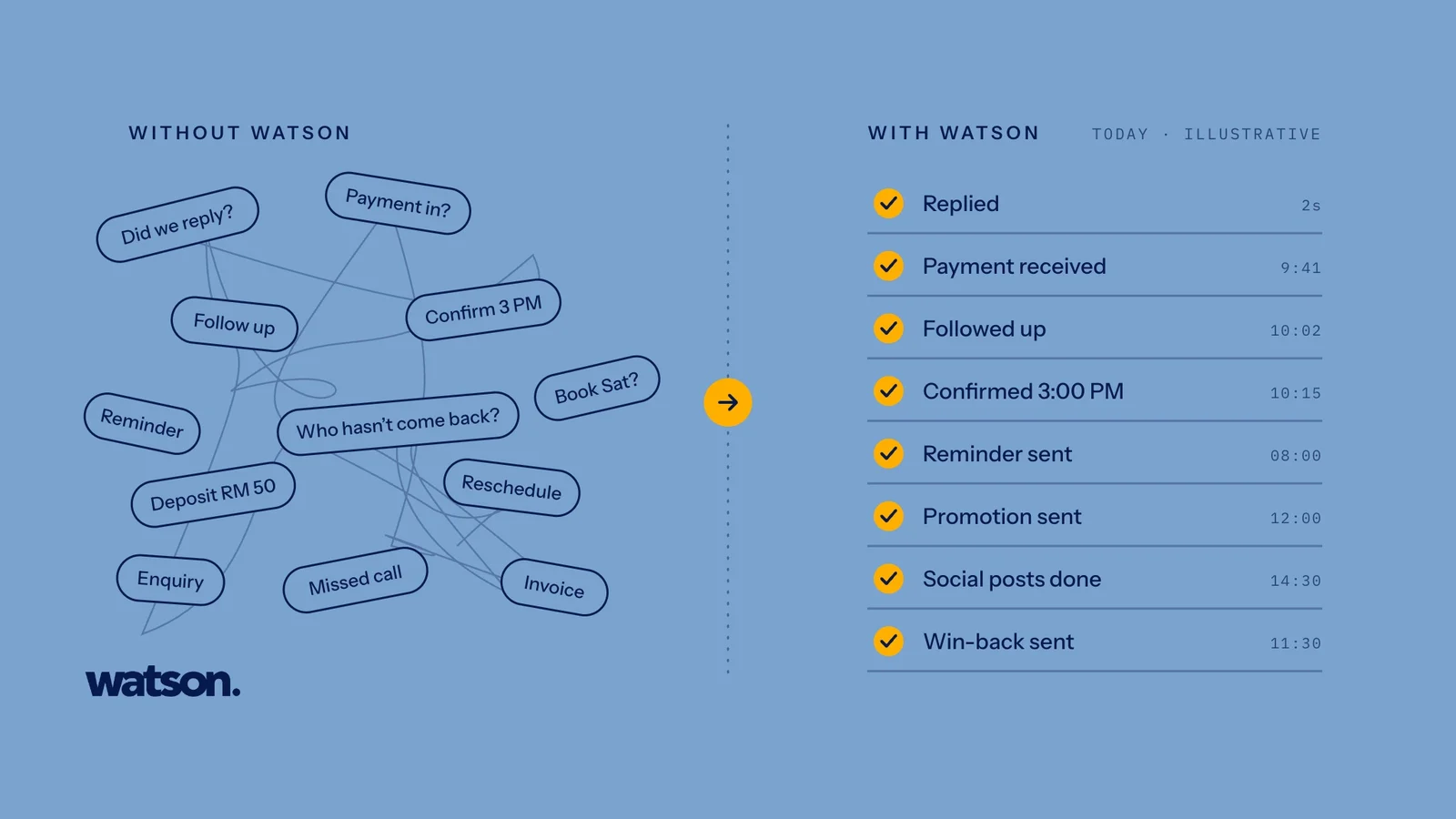
Running a business is doing ten jobs at once.
You are not only responsible for making decisions, looking after customers and growing the company. You are also responsible for remembering whether everything that needs to happen actually happened.
- Did someone reply to that enquiry?
- Was tomorrow’s booking confirmed?
- Has the customer paid their deposit?
- Did anyone follow up with the leads from yesterday?
- Did all the reminders go out?
- What are we posting this week, and is it still relevant since we last decided it?
- Which customers were supposed to come back but haven’t, and how do we reach them?
Even when you have a team, software and systems in place, a surprising amount of the business still depends on one thing.
You staying on top of it.
That is the biggest problem business automation software should actually solve. Not simply doing individual tasks faster, but making sure fewer things depend on the business owner remembering to check them.
The invisible job of running a business
Most customer-facing tasks are not particularly complicated on their own. Multiply them across dozens or hundreds of customers, though, and the problem changes.
It becomes a coordination problem. Someone always has to know what happened, what hasn’t happened, and what needs to happen next and when. In many businesses, that responsibility eventually finds its way back to the owner.
You might delegate the work. But if you still have to ask whether it was done, part of the responsibility is still sitting with you.
Having software doesn’t mean the business is automated
Most businesses already use plenty of tools: WhatsApp for customer conversations, a booking system for appointments, payment links for deposits, spreadsheets for leads, social media for marketing, and a CRM somewhere in between.
Yet the owner is still checking everything. Why?
Because having software and having actual business process automation are not the same thing. Your booking system might record an appointment. But does it make sure the customer confirms?
- Does the payment request automatically follow?
- Does the customer receive a reminder?
- Does someone follow up if they disappear?
- Does anything happen after their appointment?
When those steps are disconnected, people still have to hold the process together by hand.
That is where workflow automation software becomes more useful than adding another tool. The objective is to connect what happens next. If you are deciding where to start, how to identify the work worth automating first walks through it.
An enquiry shouldn’t create another thing for you to remember
Consider one new customer enquiry. Without automation, somebody might need to:
- notice the enquiry
- reply
- answer questions
- qualify the customer
- offer an available appointment
- confirm the booking
- request a deposit
- check whether payment arrived
- send a reminder
- follow up afterwards
Each step creates another opportunity for something to be forgotten.
Good customer service automation reduces that dependency. The enquiry arrives, gets a useful reply on WhatsApp, and the process starts moving without the owner supervising every stage.
The same applies to sales automation. A lead should not disappear because everybody became busy. With every lead in one pipeline, there is already a next step.
Bookings shouldn’t need babysitting
Getting an appointment into the calendar is only part of the job. Then come the confirmations, changes, cancellations, deposits, reminders, no-shows and follow-ups.
This is where booking automation matters. Instead of someone manually checking every appointment, the scheduling system keeps the routine parts moving, and appointment reminders go out without anyone remembering to send them.
Likewise, payment automation handles payment requests and deposits as part of the customer journey, rather than leaving someone to chase them.
That means fewer moments where the owner has to ask whether something has been handled.
Follow-up is where many customers disappear
- A customer asks for information and says they will think about it.
- A lead says they will book next week.
- A customer completes their appointment and should return in three months.
Someone says they will follow up. Then the day gets busy, a week passes, and eventually nobody remembers.
This is exactly the kind of work customer follow-up automation is designed to handle. Not because following up is difficult, but because consistently remembering to follow up with every customer is.
The same principle applies to customer retention automation. Businesses often spend heavily acquiring customers while existing ones quietly disappear, because nobody noticed they were due to return. A WhatsApp message to the customers who are due back should not depend on the owner’s memory either.
Automation means fewer things in your head
Automation is usually discussed in terms of time saved, and that matters. But there is another benefit business owners feel immediately.
Fewer things to keep track of.
- You don’t need another mental reminder to check whether the customer was contacted.
- You don’t need to wonder whether tomorrow’s appointments were confirmed.
- You don’t need to remember which customers were supposed to return.
- You don’t need to ask whether the follow-up went out.
The process already knows what should happen next. That is when automation starts changing how running the business actually feels.
Your business should keep moving without you watching it
The goal is not to remove the business owner from the business. Your judgement, your relationships and your decisions still matter. But routine customer processes should not need your attention every few minutes just to keep moving.
That is what good business automation software should provide.
- Enquiries move forward.
- Bookings get handled.
- Payments get collected.
- Customers receive reminders.
- Follow-ups happen.
- Past customers are re-engaged.
And you do not have to spend the day checking whether somebody remembered. Running the business is already enough. You should not have to babysit it too.