
Most businesses spend a lot of time trying to generate more leads.
Far less attention goes into what happens after the lead arrives.
That is where a surprising amount of conversion is won or lost.
When someone calls, sends a WhatsApp message, fills out a form or asks for pricing, they are not just another name in a pipeline. They are actively looking for an answer.
And at that moment, response time matters.
Speed to lead is the time between someone showing intent and your business giving them a meaningful response.
The longer that gap gets, the greater the chance their attention moves somewhere else. And that’s the difference between companies making hundreds of thousands, and those making millions.
Which means improving lead generation is only half the equation.
The other half is making sure the leads you already generated actually get handled while their intent is still high.
What is speed to lead?
Speed to lead is the time between a new lead showing intent and receiving the first meaningful response from your business.
That starting point could be:
- A contact form submission
- A WhatsApp message
- A missed call
- A request for pricing
- A demo request
- A social media enquiry
- Another inbound action that signals genuine interest
The important word is meaningful.
An automatic email saying “Thanks, we received your message” may confirm that a form worked, but it does not necessarily move the conversation forward.
A meaningful response answers something, asks the right next question, offers a next step or gives the person a way to continue immediately.
That distinction matters when you measure lead response time. A dashboard can say “responded in 10 seconds” while the customer is still waiting hours for an actual answer.
Why does lead response time matter?
When somebody enquires, their attention is concentrated on the problem they are trying to solve.
They may still have your website open. They may still be comparing prices. They may have their phone in their hand. They may also be contacting several businesses at roughly the same time.
The longer the delay, the more things can happen between their enquiry and your reply.
- Their attention shifts.
- Their urgency changes.
- Another business responds.
- The conversation starts somewhere else.
This is why speed to lead is not simply about being polite or providing better customer service. It can directly affect how much value you get from the leads your marketing already generated.
Buying more traffic cannot fix a response problem.
If leads are arriving and sitting unanswered, spending more to create more of them can simply create a larger pile of missed opportunities.
What does the research actually say about the five-minute rule?
The “five-minute rule” is one of the most repeated ideas in lead generation, but it is often quoted without context.
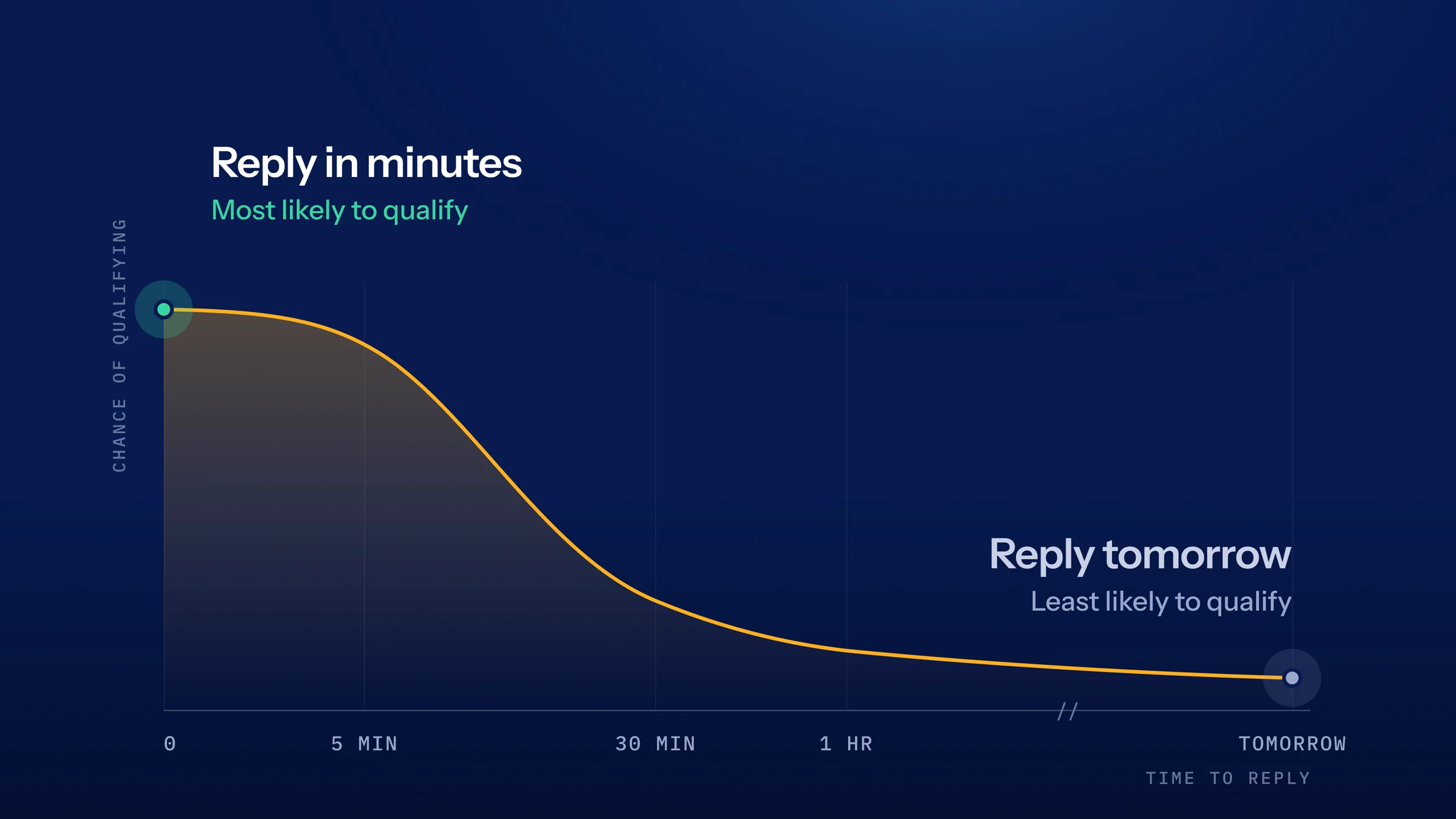
The useful lesson is not that a lead magically becomes worthless at 5 minutes and 1 second.
It is that response speed has a steep interest loss curve.
Minutes are generally better than hours, and hours are generally better than tomorrow.
For high-intent enquiries, treating five minutes as an internal operating target can be useful because it forces the business to design for responsiveness instead of relying on somebody noticing a notification.
Speed matters most when the lead is already expensive
Consider what happened before a new enquiry reached your team.
You may have paid for:
- Meta or Google ads
- SEO
- Content production
- An agency
- Landing pages
- A sales team
- Software
- Promotions
- The time required to build the brand that made someone enquire
The lead is the point where all of that investment finally produces an opportunity to have a conversation.
If the conversation starts too late, the problem is not necessarily lead generation.
It may be lead handling.
That is why speed to lead is often one of the first metrics worth checking before increasing acquisition spend.
If 100 leads arrive this month, the first question should not automatically be, “How do we get 150?”
It should also be, “What happened to the 100 we already had?”
Where speed to lead usually breaks
Most businesses do not deliberately ignore leads. Slow response tends to be a systems problem.
1. Leads arrive across too many channels
A call comes in. Then WhatsApp. Then Instagram. Then a website form. Then another message on Facebook.
If each channel has its own inbox, notifications and owner, a lead can easily disappear between them.
2. Nobody clearly owns the next response
A notification reaches three people. Everyone assumes somebody else is handling it. Nobody does.
Fast lead response needs clear ownership, even if automation is involved.
3. Leads arrive outside business hours
People do not only research products and services between your business hours.
A lead that arrives at night or over the weekend can sit untouched until the team returns. By then, the customer may already be in another conversation. And no, an automation that doesn’t get them in the door does not count here either.
4. The first reply does not actually help
Speed without usefulness is not enough.
“Hi, how can I help you?” is a poor response if the customer already told you exactly what they wanted.
Fast responses work best when the business retains enough context to continue the conversation rather than making the lead start again.
5. The first response happens, but the follow-up does not
Speed to lead gets the conversation started. Follow-up keeps it alive.
A business can respond in two minutes and still lose the opportunity if nobody continues after the first exchange.
The better system handles both.
How should a business measure speed to lead?
Start with a definition everyone agrees on. A practical formula is:
Then track more than one number.
Median lead response time
Median is usually more useful than average because one enquiry left unanswered for several days can distort the average badly.
Percentage of leads answered within five minutes
This shows consistency. A five-minute median can still hide a large group of leads waiting much longer.
Response time by channel
Calls, WhatsApp, website forms and social enquiries may behave very differently.
If WhatsApp gets answered quickly but website forms sit in email for three hours, the overall number can hide the real problem.
Response time by time of day
Separate staffed hours from evenings, overnight periods and weekends.
This often reveals whether the problem is team discipline or simply lack of coverage.
Response time by lead source
Paid leads, organic enquiries, referrals and returning customers can have different intent levels.
Knowing which sources need the fastest response makes the metric more useful.
What should the first response actually do?
Fast does not need to mean robotic.
A useful first response should do at least one of three things:
- Answer the immediate question.
- Collect the information needed for the next step.
- Move the person towards a clear next action.
For a service business, that could mean answering a pricing question, checking availability, gathering booking information or offering a suitable slot.
For a B2B company, it could mean confirming the request, collecting qualification details or arranging a conversation.
The goal is not to send something quickly.
The goal is to continue the buying journey while intent is still high.
How to improve speed to lead without asking people to stare at notifications all day
The answer is not simply telling the team to “reply faster.”
That works until somebody is busy, away from their desk, serving another customer or asleep.
A better approach is to design the response process around the lead rather than around whoever happens to see the notification.
A strong speed-to-lead system usually does five things:
Capture every inbound lead
Calls, WhatsApp, forms and other supported channels should enter a process where the lead is visible and cannot quietly disappear.
Preserve the context
The first response should know what the person asked about, where they came from and what they may already have told the business.
Respond immediately where appropriate
High-intent enquiries should receive a useful response as quickly as possible.
For some businesses, that means a person. For others, capable automation can handle the initial conversation and move it forward until staff involvement is required.
Hand over clearly
When a human needs to take over, the context should move with the conversation.
A fast automated response followed by a confused human handoff simply moves the delay further down the journey.
Keep following up
If the person does not book or buy immediately, the opportunity should not vanish because somebody forgot to send the next message.
Speed to lead and lead follow-up belong in the same operating system.
Is five minutes the right target for every business?
Not necessarily.
A five-minute target makes the most sense for high-intent inbound enquiries, especially where customers can easily compare multiple providers.
A complex enterprise enquiry may not require the same response pattern as someone asking whether a service is available this Saturday.
The more useful question is:
How quickly does this type of customer reasonably expect the conversation to start?
Then compare that expectation with what your business actually delivers.
If your answer is “within a few minutes” but your median response time is two hours, you have found a conversion problem.
Speed to lead for Malaysian businesses
For Malaysian businesses, the challenge is often less about one inbox and more about the number of places a customer can appear.
Calls, WhatsApp, social platforms, websites and other channels can all generate genuine buying intent.
The customer experiences one business. Internally, the business may experience five different systems.
That gap matters.
Improving speed to lead means reducing the distance between the moment somebody reaches out and the moment the business can actually help them.
It also means doing it consistently, including when the team is busy or the enquiry arrives outside normal working hours.
Before spending more on leads, look at the clock
Lead generation gets most of the attention because it is visible.
- More clicks.
- More enquiries.
- More names in the pipeline.
But conversion can be lost in the quiet period immediately after the lead arrives.
If your business is paying to generate demand, speed to lead is worth measuring before simply increasing the budget.
Ask:
How long does it actually take us to respond when someone is ready to talk?
Then look at the answer by channel, time of day and lead source.
You may find that the cheapest way to generate more customers is not generating more leads.
It is responding better to the ones you already have.
Where watson.my fits
watson.my can help businesses reduce the gap between an inbound enquiry and a useful response by keeping supported customer conversations connected across channels such as calls and WhatsApp.
Depending on the workflow a business configures, watson.my can respond to supported enquiries, retain conversation context, help move bookings or other next steps forward, and continue approved follow-up without requiring every interaction to wait for somebody to notice a notification.
The objective is simple: keep the leads you already paid for moving while their intent is still high.
Learn more at watson.my.